

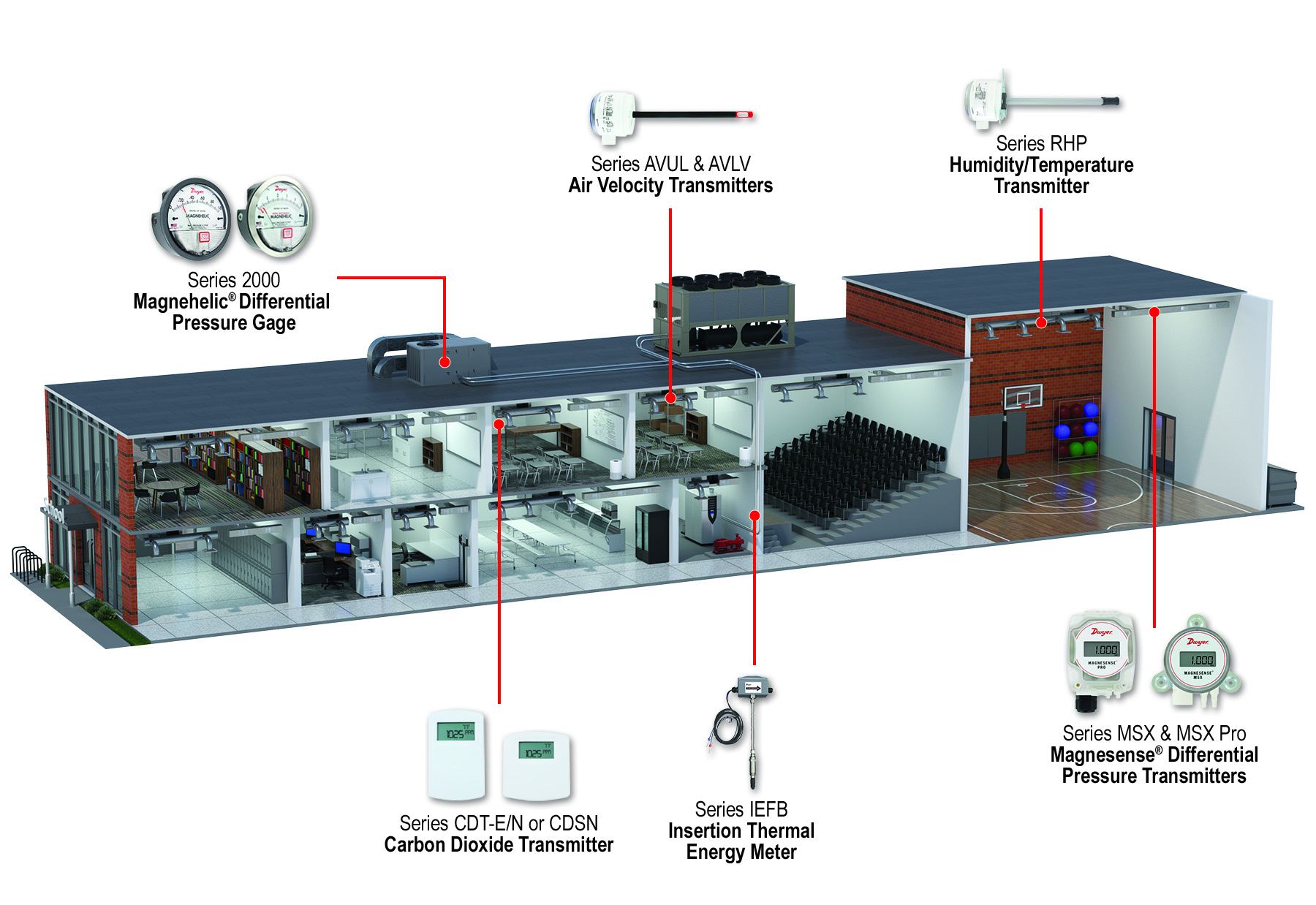
Dwyer® products are used to monitor and improve parameters that make up indoor air quality (IAQ) such as building pressure, temperature, humidity, carbon dioxide (CO2), and volatile organic compounds. This is particularly important for areas like schools, where students and teaching staff will be present for long periods of time. Our products are used in all areas of the building, including classrooms, gymnasiums, auditoriums, and nurse offices. Continue reading “Ensuring Comfortable, Safe Environments in Schools”

 At the heart of the White House “Clean Air in Buildings Challenge” is a call to action to improve indoor air quality; achieved by testing and monitoring current conditions, making a plan for improvements, implementing solutions, and maintaining those solutions. Understanding that some of these improvements can come at a significant cost, depending on the amount of improvements required or the age of a building’s HVAC system, the EPA and the White House have implemented a number of funding options to be used by the American people for the American people.

 Our understanding of COVID-19 has rapidly changed over the course of the past couple years. Initially, scientists believed that the virus was spread through large “droplets” that were expressed through talking, sneezing and coughing. These droplets were thought to be heavy enough to drop through the air rather quickly (within an average of 6 ft distances) infecting others through both droplet and surface contact. Scientists have now concluded that it is not these droplets, or even surface infection, that we should be most concerned about; the virus is actually spread through aerosol sized particles that are invisible to the naked eye and light enough to stay within the atmosphere of an enclosed space for an hour or more. Because of our newfound understanding of how this virus works, proper indoor ventilation and air quality is more important now than ever.
 Anything we do in the cloud requires data centers: streaming shows on Netflix, buying products on Amazon, storing documents on Google Drive, posting on social media platforms, hailing a ride on Uber, reserving a room on Airbnb… Data centers are essential in keeping the systems we use on a daily basis functioning and operational.