
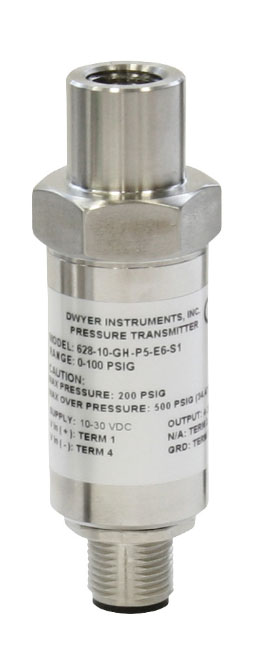
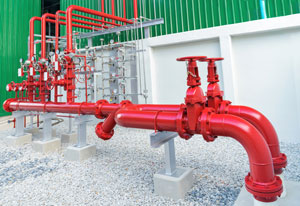
 We recently met with Aaron, a customer working on a project in West Virginia who needed to replace pressure transmitters on water transfer pump skids.
The transmitters had been installed on the discharge line, and were outside exposed to the elements. The transmitters had plastic connectors which had a tendency to degrade over time due to the wind, rain, and sun, leading to premature failure. Without functioning pressure transmitters, the pump skids themselves would shut down and limit water transfer operations. Continue reading “Pressure Transmitters Used for Pump Skids”
 The
The 

 Dwyer’s Account Executive for our test equipment portfolio, Jaden Lane, recently interviewed Erik from Technical Balance to learn more about his job, company, and relationship with Dwyer.
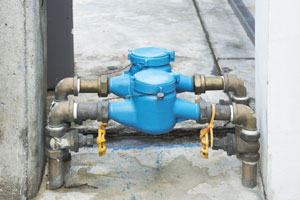 If you’re looking to purchase a new water meter, it can be hard to discern what type of meter you should pick. There are many things to consider, from the body material to the outputs to whether any approvals are required. One of the most important considerations for selecting a meter for your application is how the meter will be installed, as certain technologies can limit the meter’s installation orientation. For example, multi-jet meters measure flow by generating multiple jets of water against an impeller in an internal chamber. As the impeller rotates, the flow is totalized on the meter face. In order to meet the stated accuracy, multi-jet meters must be installed horizontally. If a multi-jet meter is installed vertically, the impeller will not rotate correctly and the readings will not meet the stated accuracy specification.